


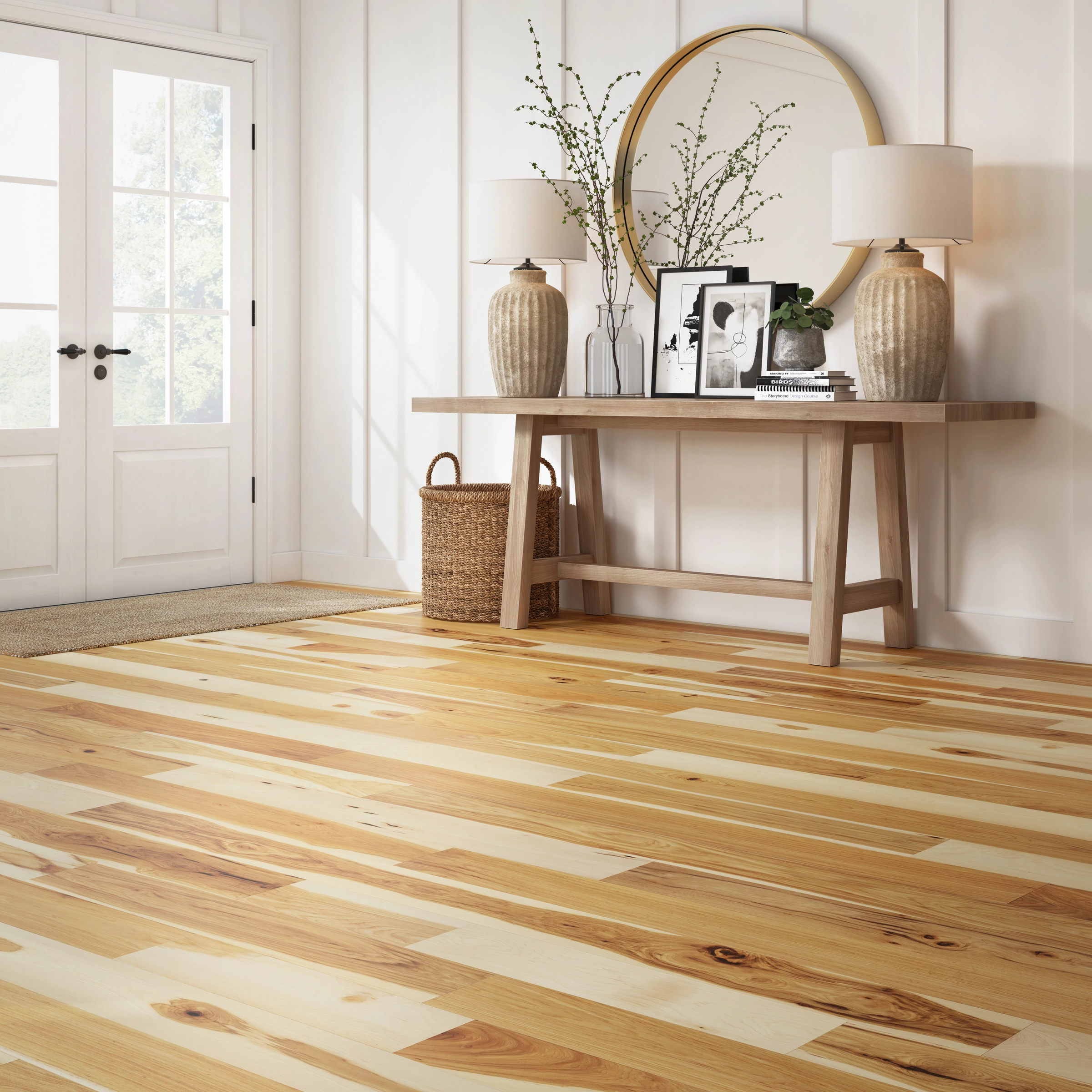
A white oak board swells and shrinks almost twice as much in one direction as it does in another. The USDA Forest Products Laboratory, whose Wood Handbook is the reference text on how wood behaves, puts white oak's movement at 10.5 percent across the growth rings and 5.6 percent across the radius from green to bone-dry. That single fact is why the way a board is sawn matters as much as the species you pick, especially in a place as humid as Charleston. Grade and cut get sold as style choices, but in the Lowcountry they are performance choices, and getting them right is what separates a floor that stays tight from one that cups and gaps by its second summer.
Two words trip up most hardwood shoppers: grade and cut. Grade describes how a board looks, how many knots and how much color change it carries, and it says nothing about how strong the floor is. Cut describes how the board was sliced out of the log, and that decides how much it moves when the air turns damp. This guide takes both apart, shows how they change the way a floor performs in a coastal climate, and tells you what to actually ask for at the showroom.
The Short Version: How to Read Grade and Cut
Grade is about appearance and cut is about stability, and a Charleston home usually wants a busy grade and a stable cut. Here is the quick version before the detail.
Grade is looks, not strength. A cleaner grade costs more only because clear lumber is rarer; it wears the same as a busy one.
Character and Common grades hide sand, scuffs and dog scratches that a clear, uniform floor would show.
Cut decides movement. Quartersawn and riftsawn boards stay flatter through humidity swings than plainsawn ones.
The busiest, most stable combination for the Lowcountry is a character-grade floor in a rift or quartersawn cut, or an engineered plank that sidesteps the movement question.
Species sets hardness. Grade and cut do not: a Select red oak and a No. 2 Common red oak are the same 1,290 on the Janka scale.
What Do Hardwood Flooring Grades Actually Measure?
Hardwood grades measure appearance, and only appearance. The National Wood Flooring Association, the trade body that writes the grading rules U.S. mills follow, sorts oak into four grades by how much natural character each board shows. Clear grade has the fewest knots and the most even color. Select allows small knots, some mineral streaking, and the color change you get when heartwood and sapwood share a board. No. 1 Common shows more knots, more open checks, and stronger light-to-dark variation. No. 2 Common, often sold as rustic or cabin grade, carries knot holes, wormholes, and dramatic color swings.
The number that surprises people is what grade does not change: strength. A Clear board and a No. 2 Common board of the same species are equally hard and equally durable underfoot. The clearer grades cost more because clear, knot-free lumber is rarer in the log, so you are paying for a calmer look rather than a tougher floor. Here is how the four grades compare.
Grade | What you see | Best for |
|---|---|---|
Clear | Very few knots, minimal color change, uniform | Formal rooms, a calm modern look |
Select | Small knots, light mineral streaks, some heartwood-to-sapwood color | A middle ground with subtle character |
No. 1 Common | More knots, open checks, clear light-and-dark variation | Family homes, a warm lived-in look |
No. 2 Common (rustic) | Knot holes, wormholes, prominent color swings | Coastal and cabin homes that take hard use |
Why Character Grade Hides Wear in a Coastal Home
A busier grade earns its keep near the water for a reason that has nothing to do with style. Sand tracked in from Isle of Palms or Sullivan's Island acts like fine sandpaper underfoot, and a floor already full of knots, streaks and color change absorbs a scuff or a dog scratch that would jump out on a clear, uniform board. The same variation that reads as charming also does real work: it buys you years before wear starts to show.
Clear grade has the opposite problem in a beach house. Its calm, even surface is beautiful when it's new and unforgiving once life happens on it, because every ding lands against a plain background with nothing to hide behind. That is why a No. 1 or No. 2 Common floor often makes more sense for a Mount Pleasant family with kids and a dog than the pricier clear grade does. You spend less and get a floor that looks better dirty than a clear floor looks clean.
How a Board Is Cut: Plainsawn, Riftsawn, and Quartersawn
The cut is the angle at which a board was sliced from the log, and it sets how the wood moves. Plainsawn is the common, affordable cut, taken straight through the log so the growth rings meet the face of the board at a shallow angle, under about 30 degrees, which gives the familiar cathedral or flame grain. Quartersawn boards are cut so the rings stand nearly perpendicular to the face, close to 90 degrees, producing a straight, striped grain and the flecks that oak is prized for. Riftsawn falls between, milled at a steady 30 to 60 degrees for a clean linear grain with no flecking.
The grain angle stops being a style question once you know how wood moves. Wood swells and shrinks far more along the growth rings than across them, and the Forest Products Laboratory's figures for red oak show the split plainly: about 11.3 percent tangential movement against 4.7 percent radial, green to bone-dry. Because a plainsawn board's rings run nearly parallel to its face, it moves on that larger tangential number and cups and gaps the most. A quartersawn or riftsawn board, with its rings turned toward vertical, moves mostly on the smaller radial number, so it stays flatter through a wet-to-dry season. Here is the trade-off in one place.
Cut | Grain look | Stability in humidity | Relative cost |
|---|---|---|---|
Plainsawn | Cathedral or flame pattern | Moves the most; most prone to cupping | Lowest |
Riftsawn | Straight, linear grain, no fleck | Very stable | Higher |
Quartersawn | Straight grain with ray fleck in oak | Stable, close to riftsawn | Higher |
Which Cut Holds Up Best in Charleston Humidity?
In Charleston's climate, a rift or quartersawn cut is the safer choice for a wide solid plank, because the Lowcountry gives wood a long, damp season to fight. Weather Spark's climate data records roughly six muggy months here, from late April into late October, with July averaging more than 30 days that feel muggy or worse. That is half the year of high moisture pushing into the floor, followed by a dry stretch when the heat runs and the boards give it back. A cut that moves on the smaller radial number rides those swings with less cupping and narrower winter gaps.
There is a second way to win the same fight, and for many homes it is the easier one: engineered construction. An engineered plank bonds a real hardwood top layer over a cross-layered core, and those opposed layers hold the board flat no matter how it was cut, which is why engineered floors can go over a concrete slab or in a below-grade room where solid wood should not. The floor still does best inside the range the NWFA publishes for wood, 30 to 50 percent relative humidity at 60 to 80 degrees, so a humidifier or a steady thermostat still earns its keep. If you want a wide plainsawn look for the grain and worry about movement, an engineered version of it is the honest answer. You can compare solid and engineered options side by side in the hardwood we carry, which spans species, grades and constructions.
Does Grade or Cut Change How Hard the Floor Is?
Neither grade nor cut changes a floor's hardness, because hardness is a property of the species. Flooring durability is measured by the Janka test, which records the force needed to press a steel ball halfway into a board, and red oak, the wood the trade uses as its benchmark, sits at 1,290, with white oak a little harder at 1,360, hard maple at 1,450, and hickory, the toughest common domestic species, at 1,820. A Select red oak and a rustic red oak carry the same 1,290; a quartersawn oak and a plainsawn oak of the same species dent at the same load. When you want a harder floor, you change the species; grade and cut leave hardness alone.
Hardness is not the whole durability story, which is where grade earns its place again. A very hard but very plain floor still shows every scratch, while a busy grade in a middling-hard species can look better after five years of real use. For a coastal home the winning combination is a hard, strongly grained species in a character grade: hickory or oak hides the marks, and the grade gives the wear somewhere to disappear.
Finish, Grade, and Keeping the Look
The finish decides how well a floor shrugs off the scratches a grade is meant to hide. Most quality hardwood now arrives prefinished, coated at the mill in a urethane loaded with aluminum oxide, a mineral that rates about 9 on the 10-point Mohs hardness scale, second only to diamond, and cured rock-hard under ultraviolet light before it ever reaches your house. That factory surface resists abrasion better than a finish brushed on site, and it's ready to walk on the day it goes down.
Sheen works with grade to manage wear. A matte or satin finish reflects less light than gloss, so it hides fine scratches and the haze of dried sea air instead of spotlighting them, and a lightly wire-brushed texture adds grip and camouflage on top. Pair a character grade with a low-sheen brushed surface and you have a floor built to look good through sandy summers and holiday crowds.
What Grade and Cut Do to the Price
Grade and cut are two of the biggest levers on what a hardwood floor costs. Clearer grades cost more because clear lumber is rarer in the log, and quartersawn and riftsawn cost more because the mill gets fewer boards out of each log when it saws for that ring angle. Species, plank width, and how much prep the subfloor needs move the number too. The good news is that the budget-friendly choices, a Common grade and a plainsawn or engineered board, are often the better performers in a coastal home anyway, so spending less doesn't mean settling.
Whatever you choose, real wood tends to pay you back. The National Association of Realtors' 2025 Remodeling Impact Report estimates that new wood flooring recovers about 118 percent of its cost at resale and that refinishing existing hardwood recovers about 147 percent, the two highest returns of any interior project the group tracks. On a Charleston home that may sell or pass down, that resale strength is part of the value, and spreading the project across a season is easy to arrange through flooring financing.
Common Questions About Hardwood Grades and Cuts
Does a higher hardwood grade mean a stronger floor?
No. Hardwood grade describes appearance, how many knots, streaks and color changes a board shows, and has nothing to do with strength. A Clear board and a No. 2 Common board of the same species are equally hard and last equally long. You pay more for a clearer grade because knot-free lumber is rarer, so the choice between grades comes down to the look you want, since the durability is the same either way.
What is character or rustic grade hardwood?
Character or rustic grade, which the NWFA calls No. 2 Common, is flooring that shows plenty of natural knots, wormholes, mineral streaks and color variation. It costs less than clearer grades and, in a busy or coastal home, hides scratches and tracked-in sand far better because there is already so much going on in the grain. The wood is just as structurally sound as a clear grade of the same species.
Is quartersawn or plainsawn better for a humid climate?
Quartersawn, and riftsawn, are the more stable choices for a humid climate like Charleston's. Wood moves about twice as much across the growth rings as across the radius, and quartersawn and riftsawn boards are cut so they move on the smaller radial number, which means less cupping and narrower winter gaps. Plainsawn costs less and shows a prettier cathedral grain, but it moves the most, so wide plainsawn planks are the ones most likely to gap.
What is the ray fleck in quartersawn oak?
Ray fleck is the shimmering, ribbon-like figure that shows up across quartersawn oak, and it comes from the wood's medullary rays being sliced lengthwise when the log is quartered. It is a prized, traditional look, most striking in white oak. If you like a straight, linear grain without the fleck, riftsawn oak gives you nearly the same stability with a cleaner, more modern face.
Does grade or cut affect refinishing?
Grade and cut do not limit whether a solid floor can be refinished; the thickness of the wear layer above the tongue does. Any solid hardwood, and engineered wood with a thick enough top layer, can be sanded and recoated as long as there is wood left to work with. Quartersawn floors often refinish especially cleanly because their flat, stable faces sand evenly, but every grade takes a refinish the same way.
Choosing the Right Grade and Cut for Your Home
The best grade and cut are the ones matched to how your home is built and lived in: how much sun and sand the floor will see, whether it sits on a slab or a raised foundation, and whether you want a calm formal look or a forgiving one. A coastal family home usually lands on a character grade in a stable cut or an engineered plank; a formal downtown room might justify clear-grade quartersawn. Seeing the boards in person settles it faster than any chart, and grain and color read differently in Lowcountry light than they do on a screen.
Palmetto Carpet and Floor Coverings has been helping Charleston-area families choose floors since 1990, and we are glad to walk you through grade, cut, species and finish for your rooms. When you are ready, request a free estimate and we will measure the space and lay out the options that fit your home and your climate. You can see and feel the grades and cuts at our Mount Pleasant showroom, or read the reviews our neighbors have left before you visit. The right floor for a Lowcountry home is the one chosen for how it will live, and after decades on these floors, it's a choice we'd be glad to help you make.


