


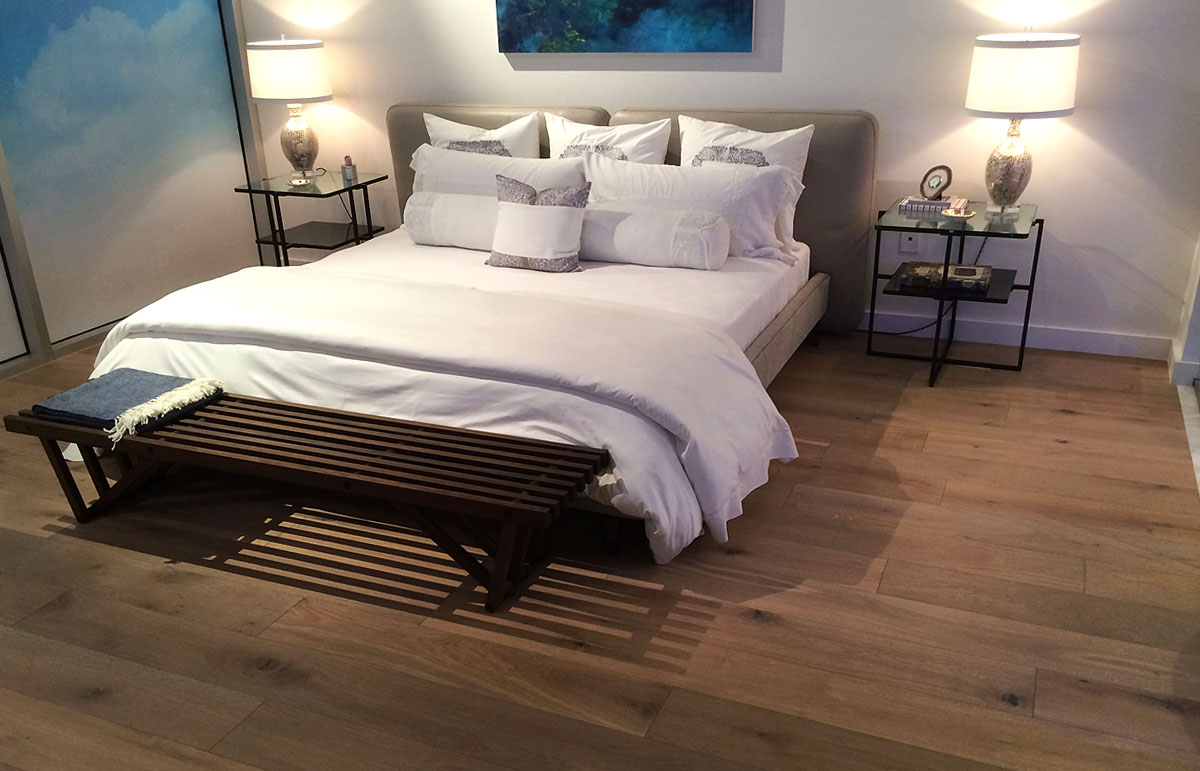
The polyurethane a finisher brushes onto a wood floor wants dry air to cure, ideally between 45 and 60 percent relative humidity, and it can turn permanently cloudy above about 70 percent. Charleston's air averages around 72 percent across the year. That mismatch is the quiet reason most Lowcountry floors are prefinished at the mill rather than finished in the house, and it's where any honest comparison of the two has to start. Both can give you a beautiful, durable hardwood floor. Which one makes sense here depends on the finish, the look you want, how much disruption you can live with, and a climate that works against a wet finish for half the year.
Prefinished hardwood arrives sanded, stained and sealed from the factory, ready to walk on the day it's installed. Site-finished hardwood goes down raw and is sanded, stained and coated in your home. Neither is simply better; they trade different strengths, and in a humid coastal market the trade-offs land differently than they would in Denver or Phoenix. Here is the whole comparison.
The Short Answer for a Charleston Home
For most Charleston homes, prefinished hardwood is the practical choice, mainly because its finish is already cured and its installation doesn't fight the humidity. Site-finished still wins for a few specific goals. Here is the quick version before the detail.
- Prefinished arrives cured and ready; site-finished needs days of careful curing in your home.
- A factory aluminum-oxide finish is harder and more scratch-resistant than a coating brushed on site.
- Site-finished gives a smooth, flat surface and a fully custom stain; prefinished has subtle beveled edges.
- Charleston humidity slows a site-applied finish and risks a cloudy cure, which prefinished sidesteps entirely.
- Prefinished usually costs less and installs faster; site-finished is easier to refinish flat and smooth later.
What Is the Difference Between Prefinished and Site-Finished Hardwood?
The difference is where the sanding and finishing happen. Prefinished hardwood is milled, stained and sealed at the factory under controlled conditions, then installed and immediately used. Site-finished hardwood, sometimes called unfinished or raw, is installed bare, then sanded smooth, stained to the color you choose, and coated with several passes of finish, all inside your home over several days. Everything else that follows, the durability, the look, the mess, the timeline, flows from that one difference.
Both start with the same real wood, so the choice isn't about quality of the boards. It is about how the surface is created and cured, and about what that means for the crew's time in your house, the air you breathe while it happens, and how the floor performs for the next twenty years.
The Finish Itself: Factory-Cured vs. Brushed On
A factory finish is the tougher of the two, and by a clear margin. Prefinished floors are coated at the mill in a urethane packed with aluminum oxide, a mineral that rates about 9 on the 10-point Mohs hardness scale, second only to diamond, and cured under industrial ultraviolet light into a bond that is harder and more scratch-resistant than anything a crew can brush on in a house. That's the opposite of a common belief that a site-applied finish is somehow more durable. It isn't; the factory process simply makes a harder surface.
A site-applied finish has its own strengths, and they are real. Because the floor is sanded flat and then coated, the finish flows into one continuous surface with no seams, and you can pick any stain color rather than choosing from a maker's prefinished palette. For a homeowner matching an existing floor or chasing a specific custom color, that flexibility is the whole point. The trade-off is that a hand-applied polyurethane, however well done, does not reach the hardness of a UV-cured aluminum-oxide coat.
The Look: Beveled Edges vs. a Flat, Smooth Floor
The clearest visual difference is at the edge of each board. Prefinished planks come from the factory with a slight bevel, a small groove where two boards meet, because the finish is already on and the edges can't be sanded flush after installation. Site-finished floors are sanded as one surface after they go down, which erases any bevel and leaves a smooth, continuous plane that many homeowners prefer, especially in a formal room.
The bevel is not purely a downside, though. That small groove hides tiny differences in board height and catches a little dust that sweeps right out, and plenty of people like the definition it gives each plank. A flat, bevel-free floor looks cleaner and more modern, but it shows a lippage or a height difference more readily because there is no groove to disguise it. The look you want is genuinely a matter of taste here, so it's worth seeing both in person before you decide.
Why Charleston Humidity Tilts the Choice
Charleston's humidity is the factor that pushes most Lowcountry projects toward prefinished, and it is the part national guides leave out. A site-applied polyurethane cures best between about 45 and 60 percent relative humidity and struggles above roughly 70 percent, where the damp air slows the cure and can leave the finish permanently cloudy, a defect finishers call blushing. Charleston's air averages around 72 percent relative humidity over the year, from about 67 percent in February to 79 percent in August, and the city runs muggy for roughly six months, from late April into late October. The season when people most want new floors is the season hardest on a wet finish.
A prefinished floor never runs that risk, because its finish was cured at the mill before it ever reached the Lowcountry. A site-finished floor can still be done well here, but it asks for tight control: running the air conditioning to pull the humidity down, giving each coat extra time, and keeping the house closed up while the finish sets. A good finisher plans for all of it. The point is that Charleston adds a degree of difficulty to site finishing that a dry-climate homeowner never has to think about.
Dust, Odor, and Living Through the Job
Prefinished installation is the cleaner, faster experience by a wide margin. Because the boards arrive finished, the crew installs them and the room is usable that day, with no sanding dust and no finishing fumes. Site finishing is a bigger event: the sanding throws fine dust that a good crew contains with vacuums and filters but never eliminates, and the finish itself gives off an odor that can linger for weeks as it cures. A site-applied floor also dries in 24 to 48 hours but can take up to 30 days to cure fully, and it has to be treated gently, no rugs, no furniture, careful foot traffic, through much of that window.
Air quality is worth a thought either way, and two labels help. FloorScore tests a finished product against California's indoor-air standard, and GREENGUARD Gold is the stricter seal you'll see on products headed into schools and hospitals. Prefinished floors carrying one of those labels arrive with their emissions already tested and low; a site-applied finish releases its compounds into your home as it cures, which is a real consideration for a household with young children, pets, or anyone sensitive to fumes.
Cost, Timeline, and Refinishing Later
Prefinished usually costs less overall and finishes faster, while site-finished trades a higher upfront cost for a custom result. A prefinished job is essentially one step, installation, so the labor is shorter and the room comes back sooner. A site-finished job adds days of sanding, staining and coating, plus the cure time, and that extra skilled labor is why it costs more. For a family that needs a room back quickly, or a whole house done in one stretch, prefinished is the easier path, and spreading the cost is simple to arrange through flooring financing.
Refinishing down the road is the one place site-finished has a lasting edge. Because it was sanded flat with no bevels, a site-finished floor can be sanded and recoated into one flat, smooth surface again years later. A prefinished floor can also be refinished, but its beveled edges make a full re-sand a bigger job. For a floor you expect to renew several times over decades, that matters, and it is part of why refinishing hardwood pays back so well: the National Association of Realtors' 2025 Remodeling Impact Report puts the cost recovery on a hardwood refinish at about 147 percent, the highest of any interior project it tracks, with new wood flooring close behind at about 118 percent.
| What matters | Prefinished | Site-finished |
|---|---|---|
| Finish hardness | Factory aluminum oxide, UV-cured, very hard | Hand-applied polyurethane, softer |
| Look at the edges | Slight bevel between boards | Smooth, sanded flat |
| Stain color | Chosen from the maker's palette | Fully custom |
| Humidity sensitivity | None; finish cured at the mill | High; needs controlled humidity to cure |
| Dust and odor | None; usable the same day | Sanding dust and fumes for days to weeks |
| Upfront cost and time | Usually lower, faster | Higher, several extra days |
| Refinishing later | Possible, harder with bevels | Easier, sands back flat |
Which Should You Choose in the Lowcountry?
Choose prefinished for most Charleston homes, and choose site-finished when a specific goal justifies the extra time and humidity control. Prefinished wins the default because its finish is harder, its installation is clean and quick, and it never fights the coastal humidity. It is the right call for a busy household, a quick turnaround, a rental, or anyone who would rather not live around dust and fumes for weeks. The prefinished hardwood Palmetto carries covers a wide range of species, colors and price points, so the palette is rarely the limiting factor.
Site-finished earns its place when the look or the match is worth the effort: a fully custom stain, a perfectly flat, bevel-free floor in a formal space, or new boards that have to blend into an existing site-finished floor. In those cases the job needs a finisher who will manage the humidity carefully, and the timeline has to allow for the cure. If that is the direction you are leaning, it's worth talking through before you buy, because the Lowcountry climate changes how the work has to be scheduled.
Common Questions About Prefinished and Site-Finished Hardwood
Is prefinished or site-finished hardwood more durable?
Prefinished hardwood usually has the more durable surface. Its factory finish is a UV-cured urethane packed with aluminum oxide, which rates about 9 on the Mohs hardness scale and is harder and more scratch-resistant than a polyurethane applied by hand in your home. Site-finished floors look smooth and refinish easily, but on raw scratch resistance the factory finish wins.
Why is prefinished hardwood better for a humid climate like Charleston's?
Prefinished hardwood is better suited to Charleston because its finish is already cured, so humidity cannot spoil it. A site-applied polyurethane cures best below about 60 percent relative humidity and can blush cloudy above 70 percent, and Charleston averages around 72 percent for much of the year. A prefinished floor skips that risk entirely, which is why it is the more forgiving choice in the Lowcountry.
Do prefinished floors have beveled edges?
Yes, prefinished planks have a small bevel along their edges, because the finish is applied before installation and the edges cannot be sanded flush afterward. The bevel gives each board definition and hides minor height differences, but it is more visible than the flat, bevel-free surface a site-finished floor gets after sanding. Whether you prefer one look or the other is mostly a matter of taste.
How long does a site-finished floor take before you can use it?
A site-finished floor is walkable in a day or two but needs far longer to cure fully. The finish typically dries in 24 to 48 hours, but it can take up to 30 days to reach full hardness, and during that time you have to keep rugs and heavy furniture off and limit traffic. A prefinished floor, by contrast, is ready for normal use the day it is installed.
Is prefinished or site-finished hardwood cheaper?
Prefinished hardwood is usually the cheaper option overall, because installation is a single step with no on-site sanding and finishing labor. Site-finished costs more for the extra days of skilled work and the cure time, and you pay for the customization it delivers. If budget and speed matter most, prefinished is the value pick; if a custom stain or a flat, bevel-free floor is the priority, the added cost buys something real.
Choosing Your Charleston Floor
The right finish method comes down to what you want most: a hard, ready-to-use floor that ignores the humidity, or a custom, bevel-free surface worth the extra time and care to create. For the way most Lowcountry homes are lived in, prefinished answers more of those questions, but the best choice is the one matched to your rooms, your timeline, and how you plan to keep the floor over the years.
Palmetto Carpet and Floor Coverings has been a family-owned Charleston-area flooring company since 1990, and we're glad to walk you through the options and show you how a prefinished floor will look in your home. You can browse the hardwood we carry online, then see and feel the finishes at our Mount Pleasant showroom. When you are ready, request a free estimate and we will measure your rooms, check the subfloor, and lay out the choices that fit your home and your climate. You can also read the reviews our neighbors have left before you visit. A wood floor chosen for how you actually live is one that keeps looking right for decades, and after all these years on Lowcountry floors, it's a choice we'd be glad to help you make.


