


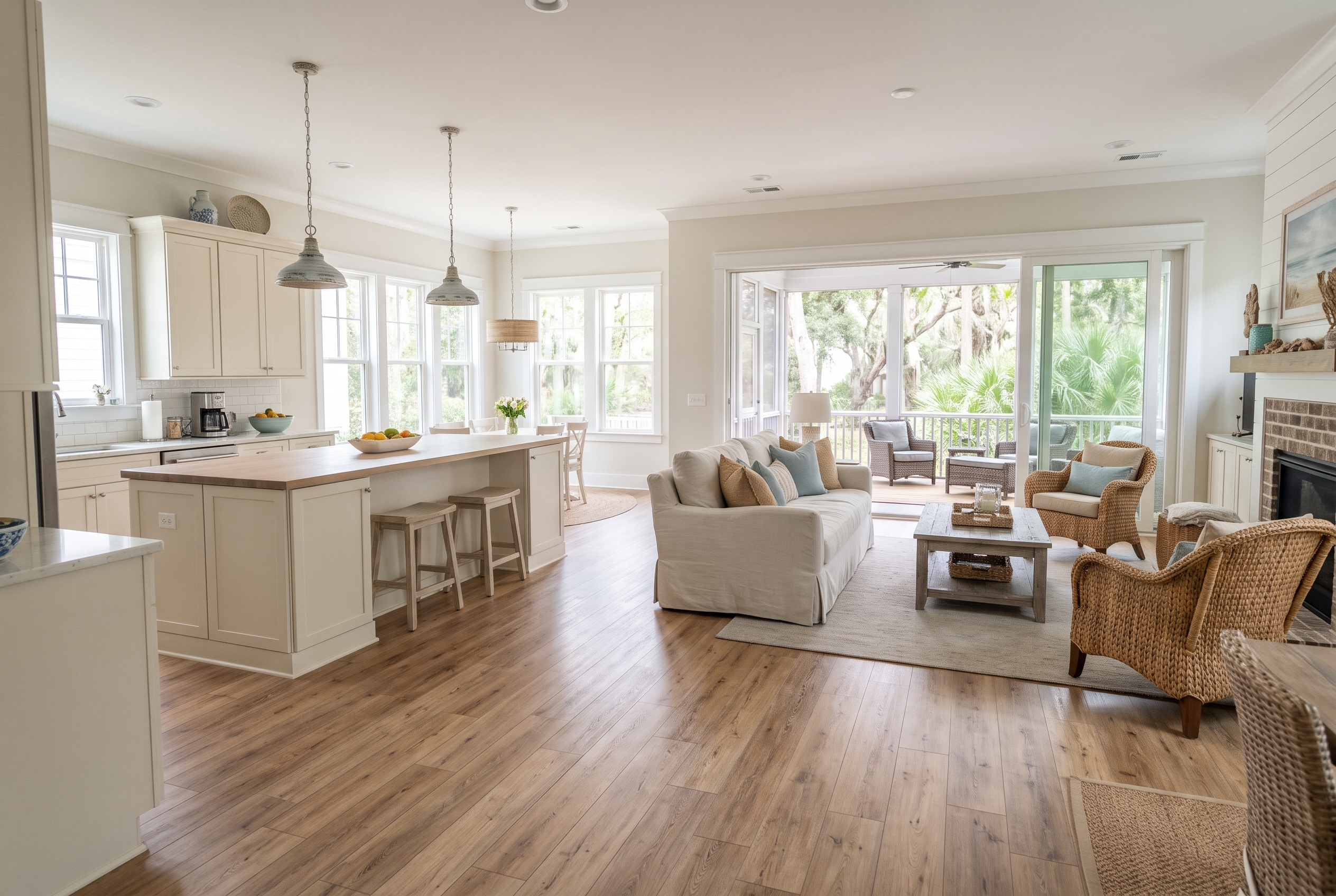
If water can stand on the floor or come up from under it, luxury vinyl plank is the safer choice. That covers a full bathroom, a laundry room and a ground-level room on a damp slab. In bedrooms, living rooms and upstairs rooms, laminate holds its own and often comes out ahead on scratches and on looking like real wood. A kitchen can go either way, depending on how often water reaches the floor in yours.
| Room | Better choice | Why |
|---|---|---|
| Full bathroom or laundry room | Luxury vinyl plank | Water stands and runs under edges |
| Kitchen | Either, vinyl if leaks have happened | Leaks start under sinks and appliances |
| Living room or bedroom | Either, laminate often | Harder surface and a convincing wood look |
| Upstairs rooms | Either, with a good underlayment | Sound carries to the floor below |
| Ground-level room on a slab | Luxury vinyl plank | Tolerates a damper slab |
| Beach house entry and pool door | Luxury vinyl plank | Wet feet and dripping towels |
How Laminate and Vinyl Plank Are Made, and Why It Matters
Laminate is a wood-fiber floor: a core of high-density fiberboard under a printed image of wood and a clear, hard top layer, with a backing underneath. Luxury vinyl plank is a plastic floor, a printed film under a clear vinyl wear layer on a vinyl or composite core. Karndean Designflooring, one of the vinyl brands we carry, builds its planks from PVC and calls them nonporous.
That core is where the two floors differ. A wood-fiber core swells if water works its way into it, and it moves a little with the humidity in the house, so laminate cares about water and air. A vinyl core can't absorb water, but it moves with heat, so vinyl cares about strong sun. The same difference makes vinyl the quieter, softer floor and laminate the one with the harder top.
SPC, WPC and Glue-Down Vinyl Plank Are Three Different Floors
SPC, or stone-plastic composite, is the thin, dense rigid core most click-together vinyl plank uses: firm underfoot, hard to dent and steady when the room's temperature changes. WPC, or wood-plastic composite, is a thicker foamed core that feels softer and warmer and sounds quieter, though it gives more under a narrow, heavy point like a table leg.
Glue-down vinyl is a thinner, flexible plank glued to the subfloor. It doesn't float, so it won't shift the way a floating floor can, but it needs a smoother subfloor, because every dip shows through a thin plank. We carry WPC planks for rooms where comfort matters most, alongside SPC and other rigid cores.
How to Read a Laminate AC Rating and a Vinyl Wear Layer
Laminate's toughness is labeled with an AC rating and vinyl plank's with a wear layer in mils, and the two numbers measure different things. The AC rating comes from a European test standard and runs from AC1 to AC6, higher meaning more resistance to wearing through the printed layer. The North American Laminate Flooring Association (NALFA) points out that its own standard doesn't use AC classes, and that impact and stain resistance are separate properties from wear.
For a busy house with dogs, kids and sand, an AC4 laminate gives you a comfortable margin, and AC3 handles the quieter rooms. A vinyl plank's wear layer is its clear top film, measured in mils, or thousandths of an inch, and a thicker layer lasts longer. Around 12 mil is a common residential layer and 20 mil or more suits a busy house; Karndean offers 20 and 30 mil layers and calls them durable enough for high-traffic commercial spaces.
| Label | What it measures | For a busy house |
|---|---|---|
| AC rating on laminate | Resistance to wearing through the top | AC4 |
| Wear layer on vinyl plank | Thickness of the clear top film | 20 mil or more |
| Plank thickness in millimeters | Overall thickness of the plank | A comfort and sound measure |
Which Handles Water Better?
Luxury vinyl plank does if you have a room where water may stand on the floor or seep under it, because nothing in it absorbs water. Karndean rates its vinyl fully waterproof and fit for bathrooms, kitchens and basements, while a laminate core can swell or buckle if water works its way between the planks. Waterproof laminate closes much of that gap, and neither floor protects the subfloor under it.
The waterproof laminate lines seal both the surface and the joints. Mohawk's RevWood, one of the laminate lines we carry, pairs water-tight joints with a waterproof finish. In a busy house, waterproof laminate for a busy family keeps spills, wet paws and dropped ice on the surface long enough to wipe them up.
Both Floors Can Handle Spills, Splashes and Wet Feet
Both floors handle everyday water when it's wiped up promptly. Laminate wants a well-wrung mop rather than a wet one, and water can sit on it only as long as the warranty on that line allows, a window that differs from line to line.
Vinyl takes a damp mop and a neutral cleaner without complaint. A mat at the sink and another at the back door keep the daily splash from ever becoming a problem on either floor.
Leaks and Standing Water Are Where the Two Floors Part Ways
A slow leak under the sink, a dishwasher hose that lets go or a toilet that overflows is where the two floors part ways. Floating vinyl planks don't swell, so once the water is out they can usually be unclicked, the subfloor dried and the same planks laid back down. Laminate boards that took on water swell at the edges and get replaced.
Under either floor, the water underneath is the bigger problem. Mohawk's instructions for its rigid vinyl say the floor can't stop mold or protect the subfloor from flooding, and that standing water should come up promptly. EPA's guidance is to dry wet materials within 24 to 48 hours of a leak, when mold usually won't take hold. Lift the planks near the leak and put a fan and a dehumidifier on the subfloor.
Which Stands Up Better to Scratches, Dents and Dogs?
Laminate is the more scratch-resistant floor and vinyl plank the more water-resistant one, so which matters more depends on your household and the room. Laminate's top is a hard, resin-saturated layer, and grit, chair legs and claws leave fewer marks on it. A vinyl plank's wear layer is softer, but a thick layer with a textured, matte surface hides fine scratches well, and Karndean notes that both floors carry wear layers made to stand up to claws.
Dents are a different matter, and the core sets the result. A rigid SPC plank shrugs off a dropped can, while a softer WPC plank or glue-down vinyl can take a dent from a narrow point load. Felt pads at least an inch across under furniture legs prevent most of it, and high heels can mark any vinyl floor.
With dogs, the two floors trade strengths: laminate resists claws but sounds louder under them, and vinyl is quieter and takes accidents in stride. In a house with dogs, vinyl goes by the water bowl and the back door, and laminate goes where they run and play. A textured or matte surface gives dogs and older family members better footing than a glossy one on either floor.
Which Is Quieter and More Comfortable Underfoot?
Vinyl plank is the quieter and slightly softer floor, and if you want the quietest of all, WPC is it. Karndean credits vinyl's flexibility for the difference and points out that a rigid laminate core amplifies hard shoes and the click of claws.
Laminate's sound depends on what's under it. A good underlayment, or a plank with one attached, takes away most of the hollow sound. In a condo, the association's sound rule sets the underlayment for either floor, so get that rule in writing before you choose.
Underfoot, vinyl gives slightly and feels a touch warmer, while laminate feels firmer and closer to wood.
Which Looks More Like Real Wood?
For a floor that looks like real wood, laminate usually comes out ahead. Its printed layer sits under a pressed texture that can follow the grain in the print, and its boards are often longer and wider. Mohawk RevWood and Karastan BelleLuxe show how far that realism goes in the laminate we carry.
Vinyl plank has caught up in many lines. Embossed-in-register texture, where the grooves in the surface line up with the printed grain, is offered on vinyl too, and a matte finish helps either floor read as wood.
Your own eyes are the test. Lay a few samples side by side on your floor, look at them from standing height and from a low angle near a window, and look for the same knot repeating across a carton.
How Sun, Heat and Humidity Affect Each Floor
Vinyl plank reacts to strong sun and laminate to humidity, so a sunroom and a house closed up for the summer test them in different ways. Mohawk's installation instructions for its rigid vinyl warn that long exposure to direct sun can discolor, fade or buckle the planks, and call for window treatments or UV-tinted glass.
Room temperature on its own matters less to vinyl than the sun hitting the planks. Mohawk's care guide for its vinyl allows rooms from 0 to 140 F, with the extremes meant for an empty house, so a beach house left warm in August is within range. The planks in front of a west-facing slider are the ones to shade from direct sun.
Laminate needs steady air rather than shade. Mohawk's laminate instructions call for a climate-controlled house at 35 to 65 percent relative humidity and 60 to 85 F for the life of the floor. A Lowcountry house shut up in summer with the air conditioning off can drift well past that humidity, so leave the system or a dehumidifier running at the maker's range while you're away.
The same Mohawk instructions keep both its laminate and its rigid vinyl out of rooms that aren't climate controlled, which rules out a seasonal porch or an open lanai for either floor.
| Property | Laminate | Luxury vinyl plank |
|---|---|---|
| Standing water | Swells if it soaks in | Unaffected |
| Scratches | Harder top layer | Softer wear layer |
| Dents | Firm | Depends on the core |
| Sound underfoot | Louder without underlayment | Quieter |
| Wood look | Usually more realistic | Close in many lines |
| Strong sun | Steadier | Needs shading |
| Humidity | Keep 35 to 65 percent | Little effect |
Which Floor Belongs in Each Room of the House?
If you're running one floor through an open plan, the wettest room it touches sets the choice for all of it, since the kitchen and the living room become one floor. Separate rooms can each get their own floor, joined at the doorway by a transition strip.
Which Floor Works in a Kitchen and an Open Floor Plan?
Either floor works in a kitchen, and if you've had a leak there before, vinyl plank is the safer pick. Choose vinyl if the dishwasher, the refrigerator's water line or the sink has leaked, or if the same floor runs on into a laundry room or a half bath. Choose waterproof laminate if the kitchen stays fairly dry and you want laminate's look and harder surface through the whole open plan.
Before either goes down, check under the sink and behind the dishwasher for old water stains, and replace any tired supply line with a braided steel one. One floor through an open plan also avoids the transition strips a change of floor needs at every opening.
Why Vinyl Plank Belongs in Full Bathrooms and Laundry Rooms
Vinyl plank is the safer floor wherever water stands, runs off a tub or overflows a toilet, which describes most full bathrooms and laundry rooms. Mohawk approves its rigid vinyl under a toilet with the gap at the flange filled with silicone caulk, and Karndean rates its vinyl for bathrooms outright.
Waterproof laminate can go in a bathroom when its maker allows it. Mohawk's laminate instructions call for the whole perimeter to be sealed with silicone over a foam backer rod, and they keep its laminate out of rooms with a floor drain or a sump pump. A powder room with no tub or shower suits laminate as well.
If the floor is part of a bigger bathroom update, we handle bathroom remodeling too, with vinyl plank, tile and some waterproof laminate among the floors we put in.
Why Laminate Often Wins in Bedrooms, Living Rooms and Upstairs
In dry rooms either floor works, and laminate often comes out ahead on scratch resistance and a convincing wood look, and sometimes on price. That makes it a strong choice for living rooms, dens, bedrooms and hallways away from the entry.
Upstairs, footsteps carry to the rooms underneath, so choose a laminate with an attached pad or a good underlayment, or a vinyl plank with a backing. Under area rugs, use a pad labeled safe for vinyl and laminate floors, since some rubber backings stain.
Why Vinyl Plank Handles a Slab or a Ground-Level Room Better
Vinyl plank tolerates a damper slab than laminate does, and Mohawk's limits show by how much. Its rigid vinyl accepts a slab that gives off up to 8 pounds of moisture per 1,000 square feet a day in a calcium chloride test, against 5 pounds for its laminate. Both floors call for that test before anything goes down.
Over concrete, laminate goes down on a vapor barrier with its seams overlapped, and both floors need the slab flat, within 3/16 inch over 10 feet for Mohawk's laminate and 1/4 inch for its rigid vinyl. Testing the slab for moisture and leveling its low spots is built into every installation we do.
A ground-level room below the flood elevation takes neither floating floor. FEMA's flood-resistant materials bulletin rates laminate as unacceptable there. It accepts vinyl only as solid sheet or tile glued with a chemical-set adhesive, so an enclosure under a raised house gets tile set in mortar or bare concrete.
What Works in a Beach House or a Rental
In a beach house, put vinyl plank where people come in wet, at the pool door, the outdoor shower and the laundry, and laminate upstairs, where sand is a bigger problem than water. Sand scratches both floors, laminate's harder top shows less of it, and mats at every door do more than any rating.
Keep a carton of spare planks from the same run in the house, stored flat in the air conditioning, so a damaged board can be replaced to match. Rentals follow the same split, and laminate in a rental earns its place in the living areas, where it stands up to move-ins and move-outs.
What Laminate and Vinyl Plank Cost Installed
HomeAdvisor's cost guide for laminate flooring installation puts installed laminate at about $3 to $13 a square foot, about $2 to $8 of it labor, with most projects at about $1,500 to $4,700 in all. Its guide to luxury vinyl installation puts vinyl plank at about $3 to $18 a square foot, with most jobs between $5 and $10 and labor at $2.50 to $6. A 560-square-foot vinyl job averages about $3,400 there.
| Room | Laminate installed | Vinyl plank installed, most jobs |
|---|---|---|
| 12-by-12 bedroom | $430 to $1,870 | $720 to $1,440 |
| Kitchen, 240 sq ft | $720 to $3,120 | $1,200 to $2,400 |
| Living room, 320 sq ft | $960 to $4,160 | $1,600 to $3,200 |
| Open plan, 500 sq ft | $1,500 to $6,500 | $2,500 to $5,000 |
The two ranges overlap so much that the line you choose matters more than the category. A basic laminate costs less than most vinyl plank, while a premium laminate and a mid-range vinyl plank land in the same place. Among vinyl installs, a floating floor runs about $4.50 to $8 a square foot and a glue-down $5 to $10, by the same guide.
The extras are similar for both. HomeAdvisor prices underlayment for laminate at $30 to $60 per 100 square feet, a vapor barrier under vinyl at $100 to $150 a room, and transition strips at $5 to $30 each. Taking up the old floor runs about $400 to $600 for 200 square feet, and hardwood, for comparison, runs about $6 to $25 a square foot installed.
How Long Each Floor Lasts, and How Each Gets Repaired
In the National Association of Home Builders' estimates of how long a house's components last, laminate gets 15 to 25 years. Those estimates came out before today's vinyl plank, so for vinyl the wear layer and the warranty are the better guides. A thicker layer takes longer to wear through, and most residential lines carry long wear warranties that differ by line.
Water at the seams shortens a laminate floor's life more than anything else, and grit and direct sun shorten vinyl's. Keep the warranty booklet with your spare planks, since it spells out what each line covers.
Both floors are repaired a plank at a time. On a floating floor, the planks are unclicked from the nearest wall back to the damaged one, or the damaged plank is cut out and a new one fitted in its place. A glue-down vinyl plank is warmed to soften the adhesive, lifted and replaced, and a spare from the same carton makes the repair hard to spot.
How to Clean and Care for Each Floor
Grit wears both floors, so sweep or vacuum with a hard-floor setting, put felt pads under furniture and keep mats at every door. After that, the routines part ways, and Mohawk's care instructions for its laminate come down to these:
- Dust mop as the main cleaning.
- Damp mop with plain water and a well-wrung mop, never a wet one.
- Keep steam mops, jet mops and scrubbers off the floor.
- Wipe up spills right away.
For vinyl plank, Mohawk's vinyl care guide and COREtec's advice line up on these:
- Damp mop with a neutral pH floor cleaner.
- Use mats with non-rubberized, non-staining backings.
- Skip wax, polish and shine products.
- Use a steam mop only where the maker approves it for your line.
Why Laminate Swells or Buckles and Vinyl Plank Gaps, and How to Fix Each
Swollen, peaked laminate seams mean water got into the core, usually from a source you can find: a dishwasher, a refrigerator line, a wet mop or a pet's favorite corner. Stop the water first, then replace the swollen boards, because they won't shrink back.
Laminate that buckles across a room has run out of room to move. Look for baseboards or cabinets pinning its edges, a missing gap at the walls or a long run with no break. Mohawk's instructions call for a T-molding in doorways narrower than 32 inches and in rooms 50 feet or longer, and freeing the edge and restoring the gap usually lets the floor settle.
Vinyl plank that gapped or peaked after a hot spell has moved with the heat, most often in front of sunny windows. Shading the windows and keeping the room within the maker's range stops it, and planks that stay lifted get re-laid. Vinyl seams that open or click underfoot point to an uneven subfloor, so the dips get filled and the planks laid again.
If the failing floor has to come out, put vinyl plank wherever water caused the problem, and fix the source before the new floor goes in.
How We Help You Choose the Right Floor for Each Room
At Palmetto Carpet & Floor Coverings, we sell and install both: laminate from Mohawk, Karastan, Pergo, Bruce, TRUCOR and Chesapeake Flooring, and luxury vinyl plank from COREtec, Karndean Designflooring, Mohawk, Karastan, TRUCOR and more. Our waterproof laminate lines include Mohawk's RevWood and Karastan's BelleLuxe Waterproof.
Our crews install laminate floating over its underlayment with an expansion gap at the walls, and vinyl plank clicking together as a floating floor or glued down, whichever suits the room. Order samples of the floors you like and lay them in the rooms they're for, or compare them side by side at our Mount Pleasant showroom.
More Questions About Laminate and Vinyl Floors
Can You Put Vinyl Plank Over Laminate?
No, take the laminate up first. Laminate is itself a floating floor, and Mohawk's instructions for its rigid vinyl list tile, sheet vinyl and wood among the floors vinyl plank can go over, but not laminate.
Vinyl plank over ceramic tile can work when the tile is flat and sound and the grout lines are filled so they don't show through. Check door clearances first, since any new floor over an old one raises the height.
Which Is Easier to Install Yourself?
Vinyl plank is a little easier if you're installing it yourself, though both click together as floating floors. It cuts with a utility knife and is lighter to handle, while laminate needs a saw and a careful expansion gap at the walls.
Both need a flat subfloor and the instructions in the carton followed to the letter, because the warranty depends on it. A bathroom, a slab or a long open plan is where a mistake gets expensive.
Do Laminate and Vinyl Plank Give Off Fumes?
Yes, both laminate and vinyl plank give off a little, as most new floors do, and certified floors are tested to keep it low. Look for FloorScore on the box or the spec sheet: it's the indoor air quality certification for hard surface flooring, developed by SCS Global Services with the Resilient Floor Covering Institute.
A FloorScore mark means the floor's emissions were tested against that standard. Ask for the certificate when you're comparing lines, and choose a certified floor for a bedroom or a nursery.
Can Laminate or Vinyl Plank Go on Stairs?
Yes, both can go on stairs, with stair nose pieces made to match the floor. On stairs the planks are glued to each tread rather than floated, and each step is cut and fitted by hand, so stairs take more labor than open floor.
Vinyl's slightly softer surface is a little quieter on stairs, and a textured finish on either floor gives better footing than a smooth one.
Can You Use Laminate in Some Rooms and Vinyl Plank in Others?
Yes, and many houses do, with vinyl in the wet rooms and laminate in the dry ones. Where the two floors meet at a doorway, a transition strip joins them and covers the expansion gaps.
The two floors usually differ in thickness, so a reducer or a T-molding bridges the height. Choosing colors from the same family keeps the change from looking like a patch where you can see both floors at once.
Does Laminate or Vinyl Plank Add More Resale Value?
No, neither adds the resale value real wood does, and buyers see both as practical wood-look floors. How buyers see laminate and vinyl plank depends more on the price of the house than on which of the two is down.
In most houses, a floor in good condition that suits each room matters more at sale than the choice between these two, so choose for the rooms and the life you live in them.
Seeing Both Floors in the Rooms They're For
The right answer is often both, vinyl plank where water lands and laminate where it doesn't. We'll walk the rooms with you, test the slab and look at the windows, then write up the floor you choose at a free in-home estimate.


