


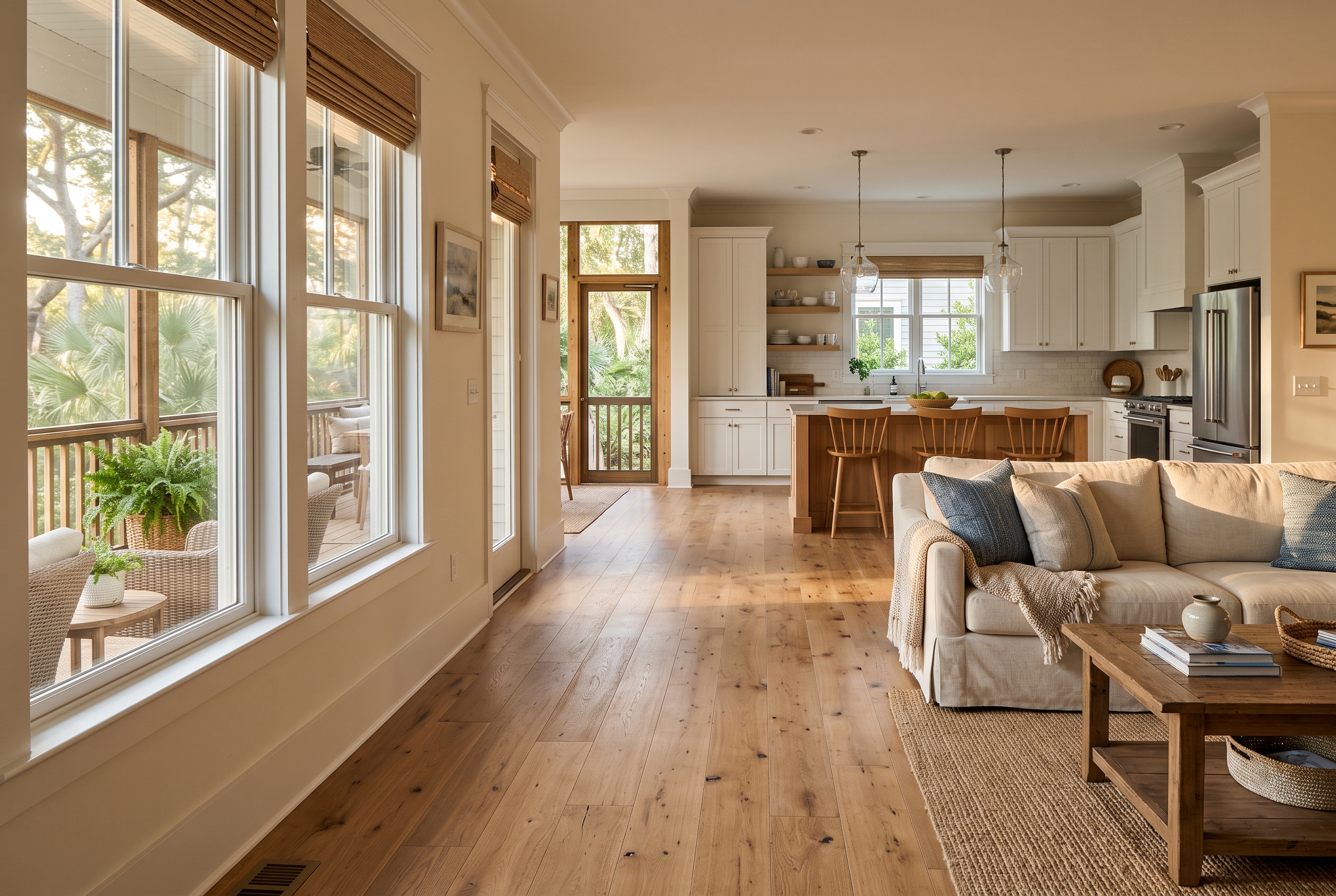
Real wood, solid or engineered, adds more resale value to most Charleston-area homes. It's the floor buyers ask for by name, and it's the floor the national Realtors' survey puts a resale number on. Laminate earns its keep another way, by replacing a worn or dated floor and matching the homes yours competes with. Three things decide which pays back in your house: your neighborhood's price level, how long you'll stay, and which rooms you're doing.
Selling within a year? Spend where a buyer would otherwise budget to rip something out. Refinish the wood you have, and replace worn carpet or damaged floors with what your neighborhood's recent sales have.
Staying five years or more? Choose the floor you want to live on, leaning toward real wood in the main rooms if your price level expects it. The years you enjoy it are part of the return.
In Mount Pleasant, downtown Charleston or on the islands, put real wood in the living areas. Buyers at these prices expect it, and anything else in those rooms goes on their renovation list.
In Summerville, Goose Creek or Hanahan, a good laminate through the main level holds its own against the newer homes you compete with. Real wood lifts your house past them.
For a rental or a flip, pick the floor the next buyer at that price expects. In most median-priced homes, that's a quality laminate or luxury vinyl.
In kitchens and baths, water decides before resale does. A water-resistant wood or a waterproof laminate suits the kitchen, and tile or luxury vinyl suits the bath. A ground-level room that sits under the flood line is different again, and takes tile set in mortar or vinyl glued to the slab.
| Your situation | Floor that holds value | Why |
|---|---|---|
| Selling within a year | Refinish wood; replace only worn floors | Buyers subtract what they'd rip out |
| Staying five years or more | The floor you want; wood if expected | Wood renews with a refinish |
| Mount Pleasant, downtown, the islands | Real wood in the main rooms | Buyers at these prices expect wood |
| Summerville, Goose Creek, Hanahan | Quality laminate, or wood to stand out | Laminate matches newer homes; wood beats them |
| Rental or flip | Quality laminate or luxury vinyl | Durable, and what buyers expect there |
| Kitchen or bath | Water-resistant wood or laminate; tile in baths | Water damage costs more than floors add |
| Ground level under the flood line | Tile in mortar or glued vinyl | Wood and laminate aren't flood-resistant |
Does Hardwood Add More Resale Value Than Laminate?
Yes, in most homes, because real wood is the floor buyers go looking for. The gap is narrowest in homes near the middle of our market. It disappears altogether when the wood is worn and the laminate is new, since buyers react to condition before they react to material.
The National Association of Home Builders asked more than 3,000 recent and prospective buyers what they want, and about four in five rated hardwood on the main level as essential or desirable. That put it on the builders' short list of most-wanted features, next to a laundry room and a patio, a list laminate doesn't appear on.
That doesn't make laminate a poor choice. A scratched, gray wood floor can lose to a fresh laminate on listing day. Wood's advantage belongs to wood in good shape, in a house where buyers were hoping to find it.
How Much Value Do Hardwood Floors Add?
On paper, more than they cost. When the National Association of Realtors and the remodelers' trade association surveyed their members, agents put the value added by refinishing hardwood at about 147 percent of the cost of the work. New wood flooring came in at about 118 percent. Those were the two best returns of any interior project in the survey.
Those figures are agents' estimates of what a project adds, set against remodelers' typical costs, for an average-size house with standard materials. Nobody measured them from actual sale prices. A floor covering half your house, in a neighborhood where buyers expect wood, won't behave like the survey's typical project.
The same survey shows how agents actually advise sellers. About one in five recommended refinishing wood floors before a sale, and about one in eight recommended new ones. Refinishing tops the list because it costs little for what it shows. A new floor is a bigger bet, and it pays best when you'll live on it for a few years first.
You'll find other percentages online, some lower and some higher. Treat each as an estimate for a typical house. The figure that matters for yours is the price gap your agent can see between recent local sales with wood and without it.
Does Laminate Add Value or Hurt Resale?
Yes, it adds value, when it replaces something buyers would pull out and when the homes you compete with have it too. Stained carpet and dated sheet vinyl are the usual candidates. Laminate protects your price more than it raises the ceiling, and it only reads as a step down where buyers at your price expect real wood in the main rooms.
It helps to know what a buyer is looking at. Laminate is a layered floor, with a core of wood fibers pressed under heat, a printed layer that carries the wood look, and a clear wear layer on top that takes the scratches. Today's better laminates are convincing to the eye and tough underfoot, and part of our laminate catalog is made to be waterproof.
The difference at resale is how each floor gets renewed. Laminate isn't sanded and refinished the way wood is. A damaged plank is swapped for a new one, and a floor that's worn all over is replaced. So a laminate floor's resale value is mostly its condition on the day you list.
The Realtors' survey doesn't put a figure on laminate, so its value shows up another way. The house shows well, draws fewer objections and doesn't hand the buyer a flooring project. If you're still learning what's out there, our guide to laminate flooring covers the looks and the constructions.
Does Engineered Hardwood Count as Hardwood When You Sell?
Yes. Engineered hardwood is real wood, a top layer of hardwood over a layered wood core, and buyers and appraisers read it as a wood floor. The National Wood Flooring Association lists it among the types of real wood flooring alongside solid. In a listing, it's correctly described as engineered hardwood.
A careful buyer's next question is whether it can be refinished, and the answer is in that top layer. Engineered wood can be sanded, though not as many times as solid. The association's refinishable certification asks for a top layer of at least 2.5 millimeters, about 3/32 of an inch, on a factory-finished floor.
Ask for the wear-layer thickness on the spec sheet before you buy. A thick one gives you, and the next owner, the option to sand the floor back to fresh wood years from now.
Engineered wood is also the construction that suits most Lowcountry houses, because it moves less with humidity and can go over a slab. Our comparison of engineered and solid hardwood in Lowcountry humidity goes through when each makes sense. Both are in our hardwood catalog, where engineered makes up most of the colors.
How Appraisers Look at Your Floors
Floors do affect an appraisal, but not by what you paid for them. The appraiser rates the quality and the condition of the house, with floor material as one part of the interior. Then the value is adjusted against comparable sales, the recent sales nearby that an appraiser or agent measures your house against, by what buyers in your market actually pay for the difference.
Fannie Mae and Freddie Mac publish the rating definitions appraisers use, and they never name a material. They grade floor coverings by level. Economy floors meet minimum standards, standard floors sit a step up, and upgraded or high-grade floors exceed standard quality and durability.
The interior gets its own ratings, separate from the exterior, so floors carry real weight there. The same definitions apply whether the appraisal is for a sale or a refinance.
Condition is rated on its own scale. New or newer floor coverings count among the updates that lift a well-kept house into a better condition band. Worn finishes or carpet that shows its age count as ordinary wear, and badly worn or damaged floors fall a band lower.
Fannie Mae's rules also say an appraiser's adjustments must follow the market's reaction, and a rule of thumb won't do. There's no fixed deduction for laminate and no fixed bonus for oak. What moves your appraisal is whether the floors are in good shape, and whether they match the rest of the house and the homes that sold near you.
| What the appraiser sees | How it's graded | What it means for you |
|---|---|---|
| New or recently installed floors | An update; supports better condition | List it with dates |
| Worn finish or carpet showing age | Ordinary wear | Buyers notice it too |
| Damaged or badly worn floors | Needs repair soon | A cost the buyer subtracts |
| Floors under the house's finish level | Weighs on interior quality | Matters most in upper-price homes |
| Floors that match the house and area | No adjustment needed | The goal |
Before the appraisal, give your agent a short list of what you've updated, with dates and product names. The appraiser then has it in hand for the walk-through.
What Charleston Buyers Expect at Your Price Point
Our market spans roughly a tenfold price range, and the floor buyers expect moves with it. The Charleston Trident Association of Realtors' annual figures put the median sale near $390,000 in Summerville and Goose Creek and about $424,000 in Hanahan. Mount Pleasant runs from about $880,000 to $990,000, downtown Charleston about $1.26 million, Isle of Palms about $1.8 million and Sullivan's Island about $4.2 million.
Around the Lowcountry median, the homes a buyer tours alongside yours are often newer, and many came from the builder with carpet and vinyl or laminate floors. A good laminate through your main level keeps you even with them. Real wood makes yours the listing they remember, and that's how wood earns its keep at this price.
In Mount Pleasant and downtown, buyers walk in expecting real wood in the living and dining rooms, and many of the homes they compare you with have it. Laminate in a bedroom or a bonus room won't cost you. In the main rooms, anything else tends to become a line on the buyer's renovation list.
On Isle of Palms and Sullivan's Island, buyers expect real wood or tile in the living areas and finishes that match the price. Engineered wood is the usual answer there, because it's real wood that moves less with the humidity than solid boards.
Awendaw and the rural edges of the county vary lot to lot, so there your comps matter more than any rule. Anywhere in our area, ask your agent for the homes that sold in your neighborhood over the last six months, with their listing photos and remarks, and look at the main rooms. If most have wood, wood is the price of admission. If most have laminate or luxury vinyl, a good laminate keeps you even and wood puts you ahead.
How Long You Plan to Stay Changes the Answer
If you're not sure when you'll sell, plan for the floor's condition on listing day, because that's what pays. Nationally, sellers now stay a median of 11 years before selling, a record in the National Association of Realtors' yearly profile of buyers and sellers. That's long enough for any floor to show its life.
Selling within a year or two means the floor has to earn its cost in the listing. Spend on what a buyer would otherwise subtract, such as the stained carpet, the damaged room or the worn finish, and leave sound floors alone.
Three to seven years out, pick a floor you'll enjoy that will still look current when you list. A natural mid-tone, a texture that hides wear and a construction that suits the room will age well. So will a classic look, since a buyer should see a floor that looks cared for and not dated.
At ten years or more, the lifespan question becomes the resale question. Real wood can be refinished before you list and look close to new. A solid floor can be sanded many times, and an engineered floor with a thick enough top layer can be sanded too. A quality laminate holds its looks for years in the right rooms, so plan around its condition when you list, and replace any worn rooms then.
Whichever you choose, keep it in listing shape as you go. Put felt pads under the furniture and a mat inside every outside door for the sand. Run the air conditioning through the summer, even when you're away, and wipe spills before they sit.
Where Laminate Is the Smart Resale Choice
Laminate is the smart resale floor in more houses than people expect. It's the right call when it replaces worn carpet in a home near the middle of our market, in upstairs bedrooms and bonus rooms, and in any neighborhood where the homes you compete with have it. It also suits a busy household, where the floor has to look good after years of kids and dogs.
Whether a laminate helps your listing comes down to whether it reads as quality. Buyers notice these things even when they couldn't name them:
- A realistic, embossed texture that follows the grain in the print.
- Long planks, and enough different boards that the same knot doesn't repeat across the room.
- A wear grade suited to the room. The AC rating on the box is laminate's wear grade, and the higher the number, the more traffic it's built for. Most of the laminate we carry is rated AC4.
- A quiet underlayment, so the floor doesn't sound hollow underfoot.
- Clean transitions and trim at doorways and where the floor meets tile.
- A water-resistant surface in the kitchen and at the back door.
Two of the premium laminate lines we carry, Mohawk RevWood and Karastan BelleLuxe, are compared side by side in our guide to RevWood and BelleLuxe laminate. You can browse every style we sell in our laminate catalog.
Flips, Rentals and Investment Homes
If you're flipping a house or buying to rent, the next buyer's expectations set the floor, so start from the comps at your price level. For a flip, one floor through the whole main level photographs well and makes the house look bigger. A floor that goes in quickly also shortens the time you carry the house, which is part of why laminate and luxury vinyl are common in median-priced flips.
A long-hold rental adds tenants to the picture. You want a wear grade that takes years of move-ins and move-outs, a floor that can be repaired a section at a time, and a few spare boxes put away for those repairs. Our guide to laminate for rental properties and investment homes covers choosing one for tenants.
Which Rooms Matter Most for Resale
The rooms a buyer sees first carry most of your floor's value: the entry, the living and dining areas and the part of the kitchen you see from them. One floor running through that whole main level looks bigger and more finished than three floors meeting at doorways. If you're choosing where to spend, spend there.
Mixing floors is fine when it follows a clear order. Wood on the main level with laminate or carpet upstairs is a pattern buyers see all the time. A different floor in every room downstairs reads as a patchwork, even when each floor is a good one.
In the kitchen, either can work. Choose one of the water-resistant styles in our hardwood line or a waterproof laminate, and most of all use the same floor as the rooms the kitchen opens into.
Bathrooms and laundry rooms are the place for tile or luxury vinyl, and most buyers expect tile in a full bath. You can browse our tile collection for those rooms. Laminate belongs there only when its maker calls it waterproof. Stairs should match the floor they meet at the bottom, because a staircase is one of the first things a buyer sees from the door.
| Room | Hardwood | Laminate | Better bet |
|---|---|---|---|
| Entry, living, dining | Adds the most value | At par near the median | Wood where the area expects it |
| Kitchen | Water-resistant styles work | Waterproof styles work | Match the rooms it opens to |
| Bedrooms | Welcome, rarely expected | Fine; carpet is fine too | Spend downstairs first |
| Bonus room, upstairs hall | Optional | A good fit | Laminate or carpet |
| Full bath, laundry | Rarely expected | Only if made waterproof | Tile or luxury vinyl |
| Stairs | Match the main floor | Match the main floor | Same floor as the landing |
| Ground level in a flood zone | Not flood-resistant | Not flood-resistant | Tile set in mortar |
Ground-Level Rooms That Can Flood
Neither one belongs in a room that sits under your home's base flood elevation, the height the flood map expects water to reach in a major flood. FEMA's guidance on flood-resistant materials lists solid wood, engineered wood and laminate flooring as unacceptable there, because none is rated to sit in floodwater for three days without real damage. Tile set in mortar is on its acceptable list, and so is vinyl glued down with a chemical-set adhesive on a concrete floor.
This comes up most in the elevated houses on Isle of Palms and Sullivan's Island, where the enclosure under the living floor gets finished into an entry or a game room. It comes up in low-lying slab houses too. Your elevation certificate shows where the base flood elevation sits relative to the room, and your town's building or floodplain office can tell you what's allowed in an enclosure there.
On that level, a floor that can't take a flood is a liability, and a buyer's inspector will say so. Tile is one of the floors we sell and install, so it's the conversation to have with us for a ground floor like that.
Charleston Homes That Call for a Different Answer
Four kinds of local housing change the answer here: older houses with original floors, newer homes in the growing suburbs, beach houses, and condos. In each one, something besides price decides the floor. It might be what's already there, what the builder put down, the sand and the flood rules, or the association's rules.
Historic Homes With Original Heart Pine
Keep it. If your older Charleston house still has its original heart pine, that floor is part of what a buyer of an old house is paying for. Covering it with any new floor, wood or laminate, takes it off the listing. Worn heart pine is usually a refinishing job, and replacing it is a loss.
For an addition, or a room that never had wood, choose a real wood that sits comfortably beside the original, in a tone and board width that doesn't compete with it. Older houses here often sit over crawlspaces that breathe Lowcountry air, which is one reason engineered wood is the steadier choice for the new rooms. If the addition is a kitchen, one of the water-resistant engineered styles keeps the house reading as a wood house from room to room.
Our guide to the best hardwood species for Charleston's historic homes goes through the species that suit older houses.
Newer Homes in Summerville and Goose Creek
In a newer subdivision, your house is judged against the same models on the next streets, so the resale question is what sets yours apart without pricing it past them. The update buyers notice first is the builder's carpet in the living areas replaced with one hard floor, kitchen included.
Keep an eye on your neighborhood's ceiling. Buyers compare your price with the models that sold nearby, so a floor that costs more than the neighborhood will pay for is money you enjoy, not money you get back. That argues for a quality laminate in many subdivision homes, and for wood when you'll stay long enough to enjoy it first.
Beach Houses on Isle of Palms and Sullivan's Island
At island prices, buyers expect real wood or tile on the living floors, so the question is which wood lives best at the beach. Sand is hard on any finish. An engineered wood with a wire-brushed or hand-scraped surface, both of which we carry, hides the fine scratches that a smooth, glossy floor shows.
If you rent the house some weeks, protect a good floor instead of settling for a lesser one. Put a walk-off mat inside every door, a foot rinse outside and felt pads on every chair. The ground level under an elevated house follows the flood rules first.
Condo and Townhome Floors
Before you choose condo or townhome floors, check your association's flooring rules. Many require an approved sound-rated underlayment under any hard floor, and some go further, because footsteps carry to the unit next door or underneath. A floor that breaks the rules can become a problem when you sell, since the buyer's agent will ask.
Read the master deed and the rules, or ask the property manager for the flooring requirements in writing, before you pick a floor. Laminate and engineered wood are both commonly installed in condos over an approved underlayment.
Should You Replace Your Floors Before Selling?
Usually not all of them. Two things decide which ones: whether a buyer would budget to rip the floor out, and whether your local sales make it an issue. Fix what reads as worn or damaged, refinish the wood you have, and replace only floors like stained carpet, damaged laminate or a patchwork of mismatched rooms. When the Realtors' association asks agents what sellers should do before listing, painting the whole house tops the list, and no floor project makes the top five.
- Walk the house as a buyer would, starting at the front door, and note every floor you'd want gone if you were buying.
- Ask your agent which of those the local sales make a real issue, and what similar homes with and without new floors sold for.
- Fix causes before surfaces, whether that's a leak, a humidity problem or a pet problem.
- Decide room by room, starting with the main level.
- Schedule the work to finish before the listing photos, with a few days to spare.
- Deep-clean every floor before the photographer comes, and roll up worn rugs.
If worn carpet has to go, replace it with what your neighborhood's recent sales have in their main rooms. Bedrooms can take fresh carpet at any price, since plenty of buyers still like it underfoot upstairs.
A floor that's dated but sound can be priced in. Buyers who plan to change a floor often ask for a credit, and a credit can cost you less than the work. Your agent will know which your market prefers.
| Your floor now | Before you list | Why |
|---|---|---|
| Hardwood with surface wear | Refinish it | The best-value floor project |
| Hardwood under carpet | Pull the carpet, refinish the wood | Buyers pay for wood they can see |
| Stained or matted carpet, main rooms | Replace with what your comps have | Buyers subtract it anyway |
| Damaged laminate in one area | Replace the damaged planks or room | Condition is what gets noticed |
| Sound but dated floor | Clean, repair, or offer a credit | A credit can cost less than work |
| Mismatched floors downstairs | Unify the main rooms if you can | One floor reads bigger and finished |
Hardwood Hiding Under the Carpet
Check for wood before you replace any carpet. Pull back a corner inside a closet, or lift a floor register, and you may find oak or heart pine that's been covered for decades. Plenty of older houses around Charleston and Mount Pleasant have it.
If the boards are sound and the wear is only in the finish, refinishing is the best-value floor project there is before a sale. If you find cupping, soft spots, dark water stains or boards that have been sanded thin, our guide to when to refinish and when to replace hardwood floors will help you tell which you have.
When the Floor You Have Is Already a Problem
Swollen laminate seams, cupped or gapped wood, a worn finish, pet stains and a patchwork of floors are the problems that follow a house to market. With each one, find the cause before you fix the surface. A buyer's inspector notes soft spots, lifting seams and signs of moisture under a floor, so a fresh floor laid over an unfixed leak doesn't hide anything for long.
Laminate that has swollen or peaked at the seams has taken on water, usually from a dishwasher, an ice-maker line, a pet or a wet mop. Stop the source first. Then the damaged planks come out and matching ones go in, or the room is replaced if the damage runs across it.
If you have no spare planks, the product name on your invoice or a leftover box is what lets a match be found. When the line is no longer made, planks can be borrowed from inside a closet to patch the kitchen, and the closet gets a close match nobody will notice. Failing that, the room is replaced.
Hardwood that has cupped or opened gaps is reacting to moisture. The cause might be humid air, a damp crawlspace, a leak or a slab giving off moisture. Fix the moisture and let the wood settle before you judge it. A cupped floor often flattens once the cause is gone, and one sanded while still cupped can end up with crowned boards.
A gray, dull or scratched wood finish is only the finish. A new coat, or a full sanding and refinishing for deeper scratches, brings it back.
Pet stains that have turned wood dark usually mean those boards need replacing, because the stain has soaked into the wood. If you're choosing a replacement for a house with pets, our guide to dog-friendly flooring covers the floors that hold up best.
A patchwork of different floors in the main rooms is the problem buyers notice from the front door, and unifying the main level fixes it when the budget allows.
Floors are on South Carolina's seller disclosure statement, along with the roof and the foundation, so a floor problem you know about goes on the form. The cleanest answer is a repaired cause and an invoice that shows it. Your agent will walk you through the form itself.
How to Describe Your Floors in the Listing
Call each floor what it is, whether that's solid hardwood, engineered hardwood, laminate or luxury vinyl, and add the species, brand and line if you know them. The buyer's agent, the inspector and the appraiser will identify it anyway, and a listing that says hardwood over laminate makes a buyer doubt everything else in it. Agents who belong to the National Association of Realtors are held by its code of ethics to a true picture in their advertising, so yours will want it right too.
You'll find the product name on the end of a leftover box, on your installation invoice or in the paperwork that came with the floor. Specific words tell a buyer more than general ones, so "engineered white oak, wire-brushed" beats "wood floors".
Put the product names, installation dates and any warranty paperwork in a folder for the buyer. Leave the leftover planks too, labeled with the product name, in the garage or a closet. Matching a floor that's no longer made is hard, and a few spare planks make a future repair simple.
What About Luxury Vinyl Plank?
Where it goes decides what luxury vinyl plank does for resale, and for most rooms it sits alongside laminate. It's a practical, wood-look floor buyers accept at most price levels, though not one they count as wood, so at the top of our market it reads in the main rooms the way laminate does.
Its edge is water. That makes it the stronger choice in bathrooms, laundry rooms, slab ground floors and the kitchens of busy houses. Our guide to luxury vinyl flooring covers how it's built and where it fits.
What It Costs Compared With What Comes Back
What a floor costs depends on your house, and the value that comes back depends on your neighborhood, so we price your rooms at a free in-home estimate instead of quoting a national figure. As a rule, laminate costs less than hardwood, for the material and the labor, and it goes in faster.
A handful of things move either price:
- The material and its construction, from a basic laminate to a premium one and from engineered to solid wood.
- What the subfloor needs, from leveling a slab to replacing soft plywood.
- Taking up the old floor.
- Stairs, which take more labor than open floor.
- The number of doorways and transitions in the layout.
To judge the payback for your house, set the estimate against the price gap your agent sees between recent local sales with wood and without it. If that gap is bigger than the extra cost of wood, wood is the better investment. If it's smaller, laminate keeps the difference in your pocket, and the years you'll live on the floor count too. If spreading the cost helps, our financing options are worth a look.
Choosing Your Floor With Us
At Palmetto Carpet & Floor Coverings, we sell and install hardwood and laminate for homes across Mount Pleasant, Charleston, Isle of Palms, Sullivan's Island, Summerville, Goose Creek, Hanahan and Awendaw, and we've been family-owned since 1990. Our hardwood runs from engineered to solid in oak, hickory, maple and more, and our laminate includes premium and waterproof styles.
Our design consultation is the place to bring the resale question. We come to you for the estimate, so we see the rooms, the subfloor and the light before we recommend anything. It helps to have your listing date if you have one, your agent's list of recent sales, and photos of anything you're worried about. You can also visit our Mount Pleasant showroom to see the floors in person, or request an appointment online.
Questions People Ask About Floors and Resale
Can Buyers Tell Laminate From Hardwood?
Yes, buyers can usually tell laminate from hardwood up close, though often not in listing photos. The giveaways are a knot or grain pattern that repeats, the edge of a plank at a vent or a threshold, a slightly hollow sound on a floating floor, and the feel of the surface. A quality laminate with a realistic texture and long planks holds up to a closer look than most.
What Floor Color Is Best for Resale?
The house and its light decide the exact shade, but the best floor color for resale is usually a natural mid-tone in the brown and beige range. It suits most furniture and hides dust and sand between cleanings. Orange-red wood and very dark or very gray floors tend to date a house to the years they went in, and very dark floors show every speck. In a beach house, a lighter natural tone suits the light.
Do Hardwood Floors Help a House Sell Faster?
Yes, hardwood floors can help a house sell faster, because they photograph and show well and draw buyers in. What speeds a sale most is a floor nobody has to budget to replace. A house with fresh, consistent floors, wood or laminate, gives buyers one less reason to wait or to ask for a credit.
Does a Flooring Warranty Transfer to the Buyer?
It depends on the warranty, since some residential floor warranties cover only the original purchaser and some can pass to a new owner. The warranty that came with your floor says which. Either way, leave the paperwork for the buyer so they know what they have.
Is Waterproof Laminate Worth More at Resale?
The room decides whether it's worth more. Waterproof laminate is worth the upgrade in kitchens, laundry areas and back entries, where buyers like a floor that shrugs off spills, and it protects the look of the floor until you sell. In the living room of a house at a price that expects wood, it doesn't change how buyers see laminate.
Do Wood Floors Lose Value in Charleston's Humidity?
No, when the floor suits the house. Engineered wood over slabs and crawlspaces keeps its shape, and so does any wood floor with the air conditioning or a dehumidifier running through the humid months. A careful install, with time to acclimate and room to expand, keeps wood flat and tight, and a flat, tight wood floor is the one buyers pay for.
Get a Floor That Fits Your House and Your Plans
Whether you're listing next spring or staying for years, the right floor is easier to see in the rooms themselves. Request a free in-home estimate and we'll come to you, look at the rooms and the subfloor, and price the floors that make sense for your house, your neighborhood and your timeline.


